
Energize Your Day: A Nourishing Matcha Tea With Orange and Rose
- Feb 17, 2025
- 3 min read
Updated: Jun 16, 2025
With its earthy, vegetal, grassy, umami notes and sweet nutty undertones, matcha has become quite popular among tea consumers. Paired with the fresh citrus flavour of orange and the delicate floral notes of rose, this calming and focused, fuelled tea may be one of your favourite ways to start your day.
In this article you will learn:
Key Ingredients
Matcha (Camellia sinensis)

High in antioxidants and originating in China, matcha is the finely ground powder from the Camellia sinensis plant ⁽¹'²⁾. Popular in Japanese tea ceremonies, matchas' vibrant green colour is due to its' unique growing environment. Developed in 16th century Japan, Camellia sinensis is grown under shade three weeks prior to harvesting, enhancing its amino acid profile, including L-theanine, and chlorophyll content ⁽²⁾.
While most other green teas involve steeping the leaves prior to consumption, matcha tea involves drinking the whole leaf increasing the amount of caffeine available. The typical serving of matcha per cup is approximately 38 - 176 mg/serving ⁽²⁾. As a comparison, one cup of coffee contains about 100 mg ⁽²⁾.
With relatively high amounts of L-thenanine in combination with caffeine, matcha helps promote relaxation, reducing stress and anxiety, enhances cognitive health, focus, and alertness reducing drowsiness, without the crash and jitters some experience after their morning cup of coffee⁽³'⁴⁾. Due to its high catechin (antioxidant) content, matcha tea has also been shown to protect the body against free radicals and oxidative stress, thereby reducing cellular damage and inflammation ⁽⁵⁾.
It may also prevent or reduce the chance of developing chronic health conditions such as cardiovascular, and neurodegenerative disorders ⁽²⁾.
Rose (Rosa spp.), FOL
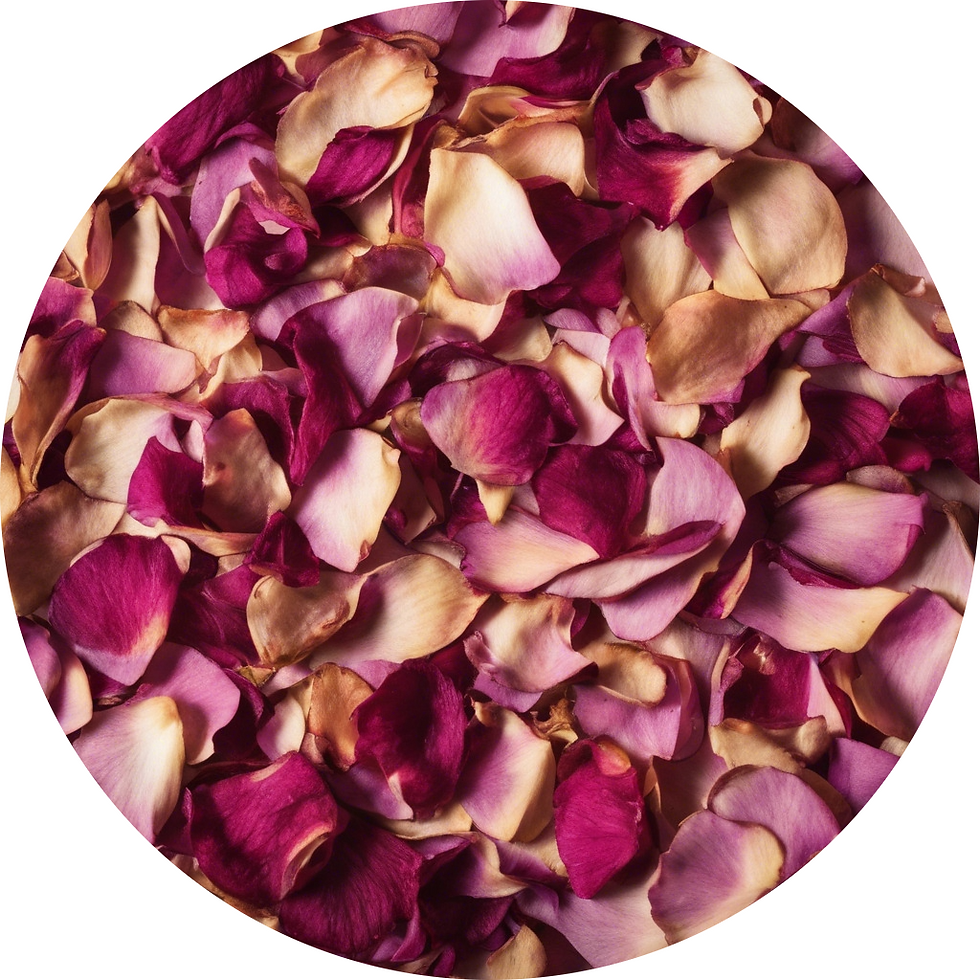
Known for its ability to soothe and calm the heart ⁽⁶⁾, rose complements matchas’ ability to promote relaxation further calming the body, mind, and spirit.
Having pleasant sweet, pungent, and floral notes ⁽⁶⁾, rose balances out matchas’ vegetal notes while complementing the earthy undertones.
Orange (Citrus x sinensis )

Containing limonene, a chemical constituent found within the peel, orange zest further adds to this beverage's antioxidant and anti-inflammatory properties, fighting both free radicals and inflammation within the body ⁽⁷⁾. Limonene has also been shown to help reduce anxiety and stress ⁽⁷⁾.
Recipe
Orange Rose Matcha Tea
Serving Size: 1 cup
Paired with the bright notes of citrus and the floral undertones of rose, this matcha tea will energize your day while providing a calming grounding effect.
Orange-Rose Simple Syrup
1/2 cup water
1/2 cup raw cane sugar
1/4 cup rose petals (food grade, organic)
1 tsp orange zest
Matcha Tea Base
3/4 cup milk of choice
1/4 cup cold water
1/2 - 1 tsp matcha powder
1-2 Tbsp orange-rose simple syrup (sweetened to taste)
Ice
Directions:
Simple Syrup
• Add sugar and water to a small saucepan over medium-high heat.
• Stir until the sugar dissolves.
• Add rose petals and orange zest. Simmer for 10-15 minutes with the lid on.
• Remove from heat and allow to cool to room temperature.
• Strain out the rose petals and transfer the syrup to a clean jar.
• Store in the fridge. Keeps well for 1 week.
Matcha Tea
• Sift matcha into a cocktail shaker using a mesh strainer. Then add the water, milk, ice and simple syrup.
• Shake for 10-15 seconds.
• Pour into a cup with ice.
• Enjoy
You can also enjoy the syrup on pancakes, waffles, and more!
Conclusion
Providing an energizing boost to your day we invite you to savor the earthy richness and invigorating qualities of matcha, complemented by the floral notes of rose and bright citrusy flavours of orange.
References:
1. The history of matcha [Internet]. Matchaful [cited 2025 Jan 3]. Available from: https://www.matchaful.com/pages/the-history-of-matcha#:~:text=The%20Origin%20of%20Matcha&text=Matcha%20dates%20back%20nearly%20a,the%20Tang%20Dynasty%20in%20China.
2. Kochman J, Jakubczyk K, Antoniewicz J, Mruk H, Janda K. Health benefits and chemical composition of Matcha Green Tea: A Review [Internet]. Multidisciplinary Digital Publishing Institute; 2020 [cited 2025 Jan 3]. Available from: https://www.mdpi.com/1420-3049/26/1/85
3. Unno K, Furushima D, Hamamoto S, Iguchi K, Yamada H, Morita A, et al. Stress-reducing function of matcha green tea in animal experiments and clinical trials [Internet]. Multidisciplinary Digital Publishing Institute; 2018 [cited 2025 Jan 4]. Available from: https://www.mdpi.com/2072-6643/10/10/1468
4. Giesbrecht, T., Rycroft, J. A., Rowson, M. J., & De Bruin, E. A. The combination of L-theanine and caffeine improves cognitive performance and increases subjective alertness. [Internet] Nutritional Neuroscience; 2010 [cited 2025 Jan 4]. Available from: https://doi.org/10.1179/147683010X12611460764840
5. Pham-Huy, L., He, H., Pham-Huy, C. Free radicals, antioxidants in disease and health [Internet]. U.S. National Library of Medicine; [cited 2025 Jan 7]. Available from: https://pubmed.ncbi.nlm.nih.gov/23675073/
6. Rose [Internet]. Herbal Academy. [cited 2025 Jan 7]. Available from: https://herbarium.theherbalacademy.com/monograph/rose/
7. Memon N, Suyog P. What is limonene good for? uses, 5 health benefits & side effects [Internet]. MedicineNet; 2022 [cited 2025 Jan 7]. Available from: https://www.medicinenet.com/what_is_limonene_good_for/article.htm


